Burning Both Ends
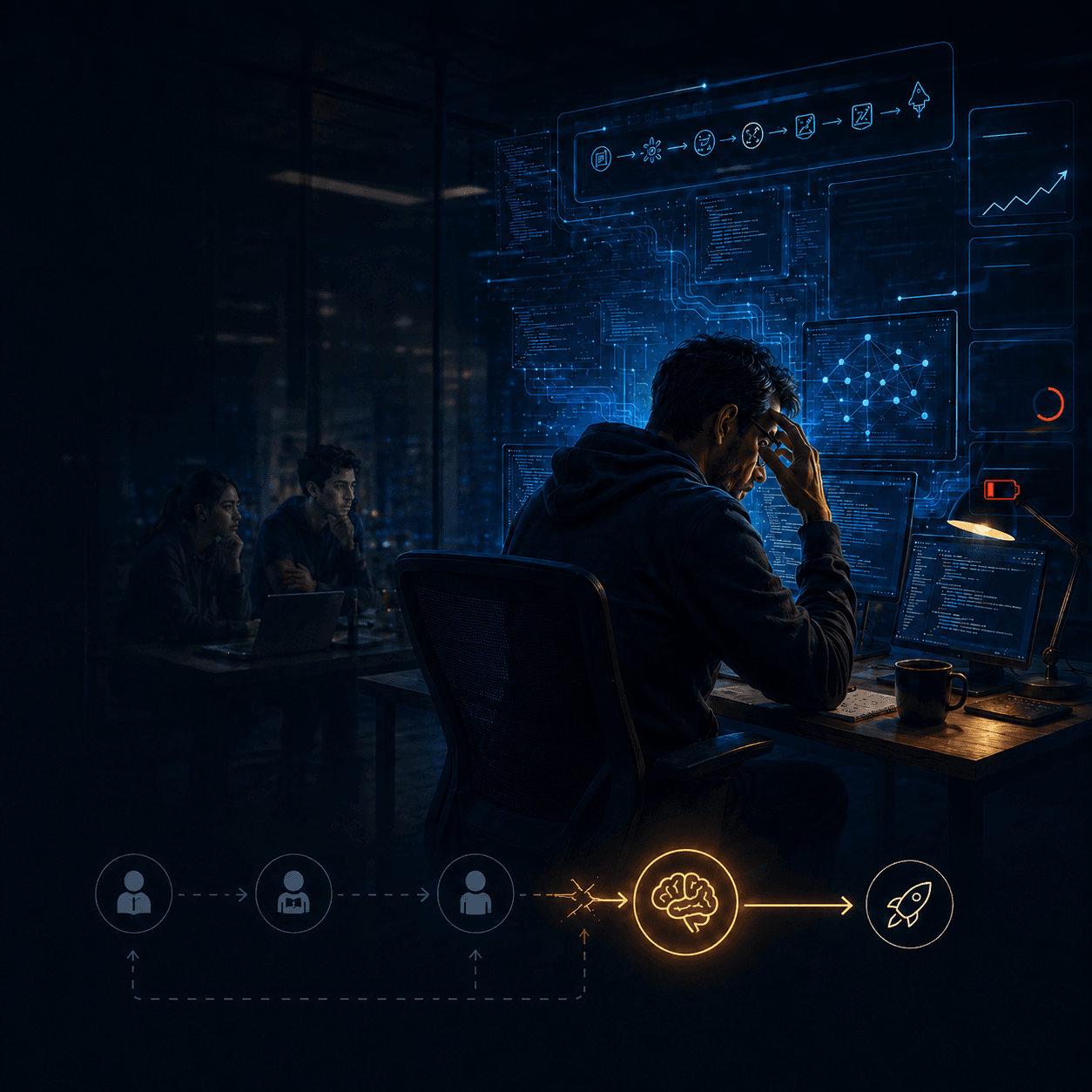
Two things are true right now at every shop that's serious about AI-assisted development. The senior engineers have never shipped more, and they've never been more tired. And the junior engineers are worried about never being invited to the party.
I've watched both happen at Lineate. They look like separate problems: one belongs in the wellness column, the other in the hiring column. They're not separate. They're one problem. We are consuming senior judgment faster than we ever have; the source that makes more of it has been quietly shut down.
The vampire is real
Steve Yegge gave it a name this past February 2026: the AI Vampire [1]. His version is the energy vampire — being in the room with these tools drains people, even while the work is going great. By May, Marc Andreessen was describing "AI vampires" on the a16z podcast: engineers who stop sleeping, bags under their eyes, completely exhausted — and euphoric [2]. We have been calling it Vampire Syndrome, almost certainly not our own spin on how to name the idea. Whatever you call it, it's the same animal.
Here's the mechanism, as near as I can tell. Traditional programming had rest built into it. You figured out what to build, and then you sat and typed it, and the typing was cognitively cheap — your fingers worked while your brain idled. Agents deleted the cheap part. What's left is the expensive part, wall to wall: review, decision, redirect, judgment call, all day long. And because the agent is always ready with the next thing, walking away feels like leaving features on the table. Yegge again: "Agentic software building is genuinely addictive, and the better you get at it, the more you want to use it" [1].
The numbers are starting to back the anecdotes. One engineering-analytics firm measured a roughly 20 percent rise in out-of-hours commits among developers using AI tools [3]. Upwork found that 96 percent of executives expected AI to raise productivity, while 77 percent of employees actually using it said it had added to their workload [4]. And in the one randomized trial we have, experienced open-source developers using early-2025 tools took 19 percent longer on tasks with AI — and walked away convinced they'd been 20 percent faster [5]. The tools have improved plenty since then, but I'd bet the durable finding is the gap itself: the felt speed and the clock don't agree. That's what makes this a vampire and not just a busy quarter. It feels like flying, even as it drains you.
I've put in absurd days this way and felt great about the output and lousy about everything else. The euphoria is not a reliable meter. We need to say that out loud, because pretending the cost isn't real doesn't make it go away — it just makes it invisible until somebody good burns out.
The bench is empty
While the seniors burn, the entry level is disappearing. New graduates made up just 7 percent of Big Tech hires in 2024 — down a quarter from 2023 and more than half from 2019 [6]. A Stanford team working with payroll records from millions of workers found that employment for 22-to-25-year-olds in the most AI-exposed occupations was down 16 percent relative to their peers, while older workers in the same occupations held steady or grew; young software developers, specifically, were down nearly 20 percent from their late-2022 peak [7]. Recent computer science grads are running about 7 percent unemployment — computer engineering closer to 8 — against 4.2 percent across all majors [8]. The Stanford authors are careful to say their data is consistent with AI displacement rather than proof of it. Fair enough. From where I sit, the mechanism isn't mysterious: the work we used to hand juniors is precisely the work agents do best.
But the jobs are only the surface. The deeper loss is that those first-rung tasks — the small bug fix, the CRUD endpoint, the test coverage nobody wanted to write — were never just output. They were the curriculum. That's where pattern-matching came from: writing code, breaking it, debugging it at 6 pm with someone more senior looking over your shoulder. Take away the run, and you don't just lose a hire; you lose the mechanism that turns hires into seniors.
Medicine already ran this experiment. Matt Beane spent two years observing surgical training at 18 teaching hospitals. In open surgery, the resident's hands are literally required, so apprenticeship happens by default. Robotic surgery lets the attending operate alone — residents mostly watch, and approved training methods quietly stopped producing competent surgeons. Only a minority got skilled, and they did it by breaking the rules to steal practice time [9]. His conclusion, generalized to AI in his book The Skill Code: "We've started a war between technological productivity and human skill, and skill is losing."
Now add the clock. Today's juniors will be running teams in five to seven years. The kids graduating in 2028 and 2029 will have spent the back half of high school and all of university working with AI — AI-native in a way nobody currently employed is. Somebody has to be senior enough to lead them, and seniors take years to grow, and we are currently breaking the process that grows new seniors.
One problem, two symptoms
Teams are still shaped for a world where typing was the bottleneck: seniors decide, juniors type, everyone levels up by typing progressively harder things. Agents ended that world. Judgment is the bottleneck now — and we're overdrawing it at the top of the org while depositing nothing at the bottom. Those two curves cross somewhere in the next 3-5 years.
Structure the team like a teaching hospital.
Other industries have been here. Medicine's answer to "how do you train people whose mistakes are expensive" is the residency: graduated responsibility under active review. Aviation's answer to "what happens when automation erodes the skill underneath it" was to notice — American Airlines was warning its pilots about automation dependency in its famous "children of the magenta" training class back in 1997 [10]. The FAA eventually put it in writing, warning that continuous use of autoflight systems "could lead to degradation of the pilot's ability to recover the aircraft from an undesired state quickly" and telling airlines to make pilots hand-fly [11]. Software should steal from both. Here's the approach that I would take.
-
Agent output goes to the junior first, and the senior reviews the review. The junior runs it, tests it against the spec, hunts down the obvious garbage. The senior makes one judgment pass instead of ten. The junior reads and tests —more production-probable code in six months than most of us wrote in our first three years—and reading code while someone corrects your judgment of it is the residency.
-
Juniors own whole small systems. Internal tools are perfect for this: real users, real consequences, cheap mistakes. Owning something end-to-end is where judgment compounds fastest. We do this with our own internal tools, and it works.
-
Juniors hand-code on a schedule. Some tickets get done without an agent, on purpose. Low-level data structures and algorithms must be coded by hand. Sometimes replaced by libraries before shipping, but the learning is absolutely the point: the more confidence people place in generative AI, the less critical thinking they report doing [12]. So force critical thinking and implementation skills, and evaluate on that.
-
Cap the vampire hours. Hard stops on sustained agent development — wall clock limits. Slot machines are addictive, and our developers now face a massive wall of them. We need to set them up for success to avoid this trap. Nobody will power their way out of a Skinner's Box. Structure has to do it, and the leads have to model it. The absurd hours of the most senior person on the team are the policy, even if that is the opposite of the goal.
Notice the trade-off sitting in the middle of this that is burning out the seniors. It is exactly what the juniors need to wade their way through to grow into seniors. Review is where judgment is learned. Push the load down and the correction up.
The Part that won't wait
None of this is charity for juniors. It's supply-chain management for the only input that matters in an agentic shop. You cannot hire a 2030 senior in 2030. They take five to seven years to build, the graduating classes that will need them are already in school, and the assembly line is currently unplugged. The teams that thrive in 2030 are being structured right now, mostly by accident. We should probably do it on purpose.
Author: Harrison Green-Fishback
Sources
-
Yegge, "The AI Vampire," February 2026. https://steve-yegge.medium.com/the-ai-vampire-eda6e4f07163
-
Andreessen, a16z Podcast, "Marc Andreessen on Builder Culture in the Age of AI," May 2026. https://podscripts.co/podcasts/a16z-podcast/marc-andreessen-on-builder-culture-in-the-age-of-ai
-
Multitudes data, in Lazzaro, "Addictive agentic coding has developers losing sleep," LeadDev, March 2026. https://leaddev.com/ai/addictive-agentic-coding-has-developers-losing-sleep
-
Upwork Research Institute, "From Burnout to Balance," July 2024. https://www.upwork.com/research/ai-enhanced-work-models
-
Becker, Rush, Barnes, Rein (METR), "Measuring the Impact of Early-2025 AI on Experienced Open-Source Developer Productivity," July 2025. https://metr.org/blog/2025-07-10-early-2025-ai-experienced-os-dev-study/
-
SignalFire, "State of Tech Talent Report," May 2025. https://www.signalfire.com/blog/signalfire-state-of-talent-report-2025
-
Brynjolfsson, Chandar, Chen, "Canaries in the Coal Mine?," Stanford Digital Economy Lab working paper, revised November 2025. https://digitaleconomy.stanford.edu/publication/canaries-in-the-coal-mine-six-facts-about-the-recent-employment-effects-of-artificial-intelligence/
-
Federal Reserve Bank of New York, "The Labor Market for Recent College Graduates," February 2026 update. https://www.newyorkfed.org/research/college-labor-market
-
Beane, "Shadow Learning," Administrative Science Quarterly, 2019; and The Skill Code, Harper Business, 2024. https://journals.sagepub.com/doi/abs/10.1177/0001839217751692
-
Vanderburgh, "Children of the Magenta," American Airlines Flight Academy, 1997. https://vimeo.com/159496346
-
FAA, SAFO 13002, "Manual Flight Operations," January 2013. https://www.faa.gov/sites/faa.gov/files/other_visit/aviation_industry/airline_operators/airline_safety/SAFO13002.pdf
-
Lee et al., "The Impact of Generative AI on Critical Thinking," CHI 2025. https://dl.acm.org/doi/10.1145/3706598.3713778